Traffic Security
Traffic Security covers powered and fixed vehicle access control and denial equipment: automatic rising road blockers, bollards in fixed, removable and automatic form, tyre killers and one-way spike systems, boom barriers with access control integration, and the control systems and loops behind them.
Everything here depends on separating two requirements that look similar and are not. Access control equipment manages authorised traffic at a gate and is specified on cycle speed, reliability and integration with card or plate recognition. Vehicle denial equipment is engineered to arrest a hostile vehicle at a stated mass and speed, is certified against an impact standard, and requires a foundation designed for the load it will transmit. A threat assessment, not an appearance preference, decides which applies.
This equipment is procured through tendering by defence and government facilities, police and security agencies, airport, port and border authorities, prisons and correctional facilities, municipal corporations, courts and secure government buildings, utilities and critical infrastructure operators, and security and infrastructure projects funded by development banks. Offers are built directly from the tender document and include impact certification where applicable, foundation and civil requirements, cycle time and duty data, control system details, make and origin declarations, installation and commissioning scope and inspection arrangements.
Send us your road width, control method and whether an impact rating is required, and we will specify the equipment and quote it.
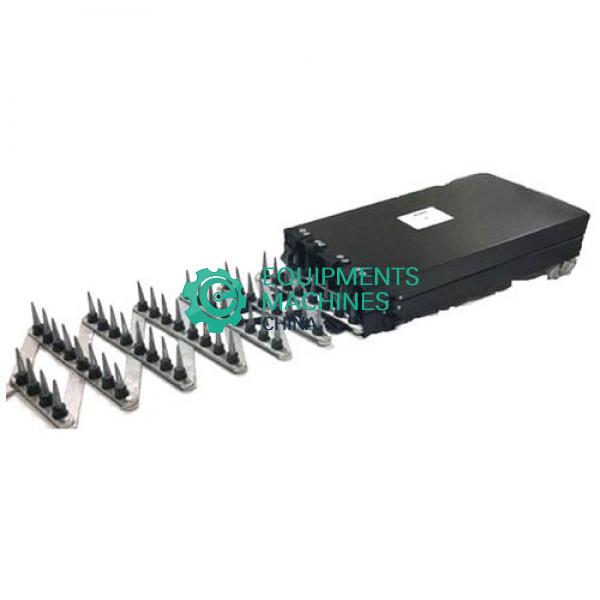
Quick answer: This range is vehicle stopping and access control equipment, currently the Automatic Road Block for police, military and secure sites. The decisions are whether you need a portable device deployed by personnel or a fixed installation at a gate, the vehicle size and speed you must stop, and how it is controlled and powered.
Traffic Security range
1 model, each linked to its full specification page.
| Product | Code | What to confirm |
|---|
| Automatic Road Block | EQMH-CHINA-MY3064001 | The Longest Remote Distance: 45m
Ejection Speed: about 2m/s |
How to choose Traffic Security
First separate portable from fixed requirements. A portable road block is carried to a checkpoint or incident by police or military personnel and deployed across the road when needed, then removed; the Automatic Road Block is described as easy to carry and developed for exactly that use. A fixed rising blocker or bollard is built into a foundation at a site entrance and operated from a guard post.
Second, define the threat. For routine checkpoints the aim is to stop or deter a vehicle that refuses to halt. For high-security sites protecting against a deliberate vehicle attack, you need equipment tested against a stated vehicle mass and speed, with an engineered foundation. These are different products and should not be substituted for one another.
Third, look at operation: manual deployment, remote control or connection to an access control system; power supply and battery backup for fixed units; and what happens if power fails, since a blocker should fail to a known safe state agreed with the user.
Specifications and standards
Compare dimensions and weight in the deployed and stowed state, the width of road covered per unit and whether units link together, deployment time, control method, power supply and backup, operating temperature range, material and corrosion protection, and, for fixed units, foundation depth and drainage needs.
For hostile vehicle mitigation at sensitive sites, buyers commonly require impact testing to a recognised standard such as ISO 22343, PAS 68 or ASTM F2656, stating the test vehicle and speed. Ask for the test report of the exact model and foundation design before tender submission, and confirm whether your requirement is a tested barrier or a deterrent device. Use of tyre deflation devices is regulated in many countries, so confirm local rules.
| Specification | Values across the range | Models listing it |
|---|
| The Longest Remote Distance | 45m | 1 |
| Ejection Speed | about 2m/s | 1 |
| Max. Extended Length | about 7.2 m | 1 |
Who buys this range
Police forces, military units and border agencies buy portable road blocks for checkpoints, convoy security and pursuit control, usually through government tenders with end-user documentation. Embassies, government compounds, airports, oil and gas facilities and prisons buy fixed blockers and bollards through security integrators who design the whole access point. Procurement normally includes technical evaluation and site surveys. Purchases are usually small in number but heavily documented, with demonstrations or samples sometimes requested before award.
Portable deployment and personnel safety
A portable road block is deployed close to moving vehicles, so the procedure matters as much as the device. Units should be deployable from the roadside without standing in the lane, and retrievable quickly so that authorised vehicles can pass. Training should cover placement, warning signs ahead of the block, and how officers stand clear. Ask for the deployment instructions and carrying case details before ordering, and plan how many units a team must carry for the road widths they work on.
Foundations and drainage for fixed blockers
A fixed rising blocker or bollard is only as strong as its foundation, and an impact rating applies only when the tested foundation design is followed. Excavation depth, reinforcement and concrete grade should come from the manufacturer's drawings and be checked by a local engineer against ground conditions. Below-ground mechanisms need a drained pit, because standing water corrodes hydraulics and electrics. Plan for underground services before digging.
Frequently asked questions
Is the Automatic Road Block portable or fixed?
The product is described as a portable unit for police and military personnel to deploy at a checkpoint or incident. If you need a fixed rising blocker built into a gate, tell us and we will discuss suitable equipment separately.
Is it crash-rated?
Do not assume a portable road block is impact-rated. Crash-rated barriers are tested against a defined vehicle mass and speed with a specific foundation. If your tender requires a rating, state the standard and level so we can confirm what can be offered.
Can it be connected to our access control system?
Fixed blockers and bollards are commonly integrated with card readers, plate recognition or a guard post control panel. Tell us the system and signals available so the interface can be confirmed.
What documents do government buyers usually need?
Buyers typically ask for technical data, operating instructions, any test reports, end-user declarations and inspection arrangements before shipment. Tell us the tender requirements early so the paperwork can be prepared with the offer.
Related ranges
Traffic Safety Products · Traffic Barrier · Traffic Protection · Traffic Cone · Traffic Warning Light · Traffic Delineator · Traffic Warning Tape · Traffic Safety Fence · Traffic Convex Mirror · Traffic Baton · Traffic Sign · Traffic Road Stud · Traffic Rubber Speed Bump · All Products
Request a quote
Tell us whether you need portable or fixed equipment, road width and number of lanes, vehicle types to be stopped, any impact standard required, control and power arrangements, end user and tender reference if applicable, quantity, and your destination port.
Request a quote for Traffic Security